

Google AI Overviews do not reward “more AI content.” They reward pages that answer one job clearly, stay crawlable, and match the entity facts Google already trusts about your brand. This checklist is the working scorecard I use with Indian SaaS and service founders when organic CTR softens and an overview starts owning the SERP.
Use it with the narrative guide Google AI Overviews: what actually moves the needle and the entity deep dive Entity SEO for AI Overviews. It sits in the What Is AI SEO? (2026) cluster.
Who this checklist is for
- Founders whose head terms now show an AI Overview and clicks fell while impressions held
- Teams that already publish blogs but still lose the summary slot to a competitor or a Wikipedia-style page
- In-house marketers who need a pass/fail scorecard for agencies — not another slogan deck
Skip this if you have no Search Console access, money pages that 404 or noindex, or no one who can ship HTML/copy changes in the next two weeks. Fix crawl and ownership first.
How to score yourself (10 minutes)
For each section below, mark Pass / Partial / Fail. A page ready for overview competition usually needs:
- All Technical gates = Pass
- At least 4 of 6 Content & passage checks = Pass
- Entity consistency = Pass on name, founder, and offer
- One measurement habit in place (even a simple sheet)
Do not optimize every URL. Pick five queries where an overview already appears, map each to one primary URL, and run this checklist on those five only.
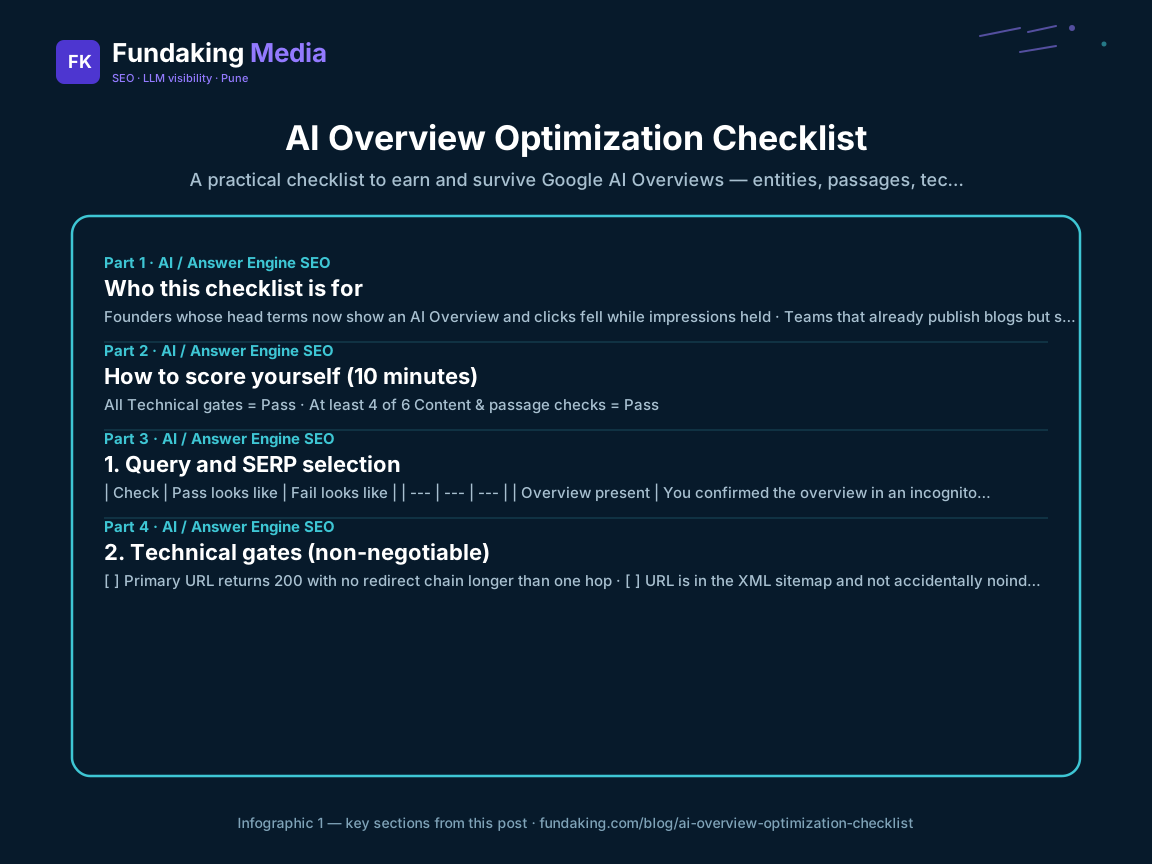
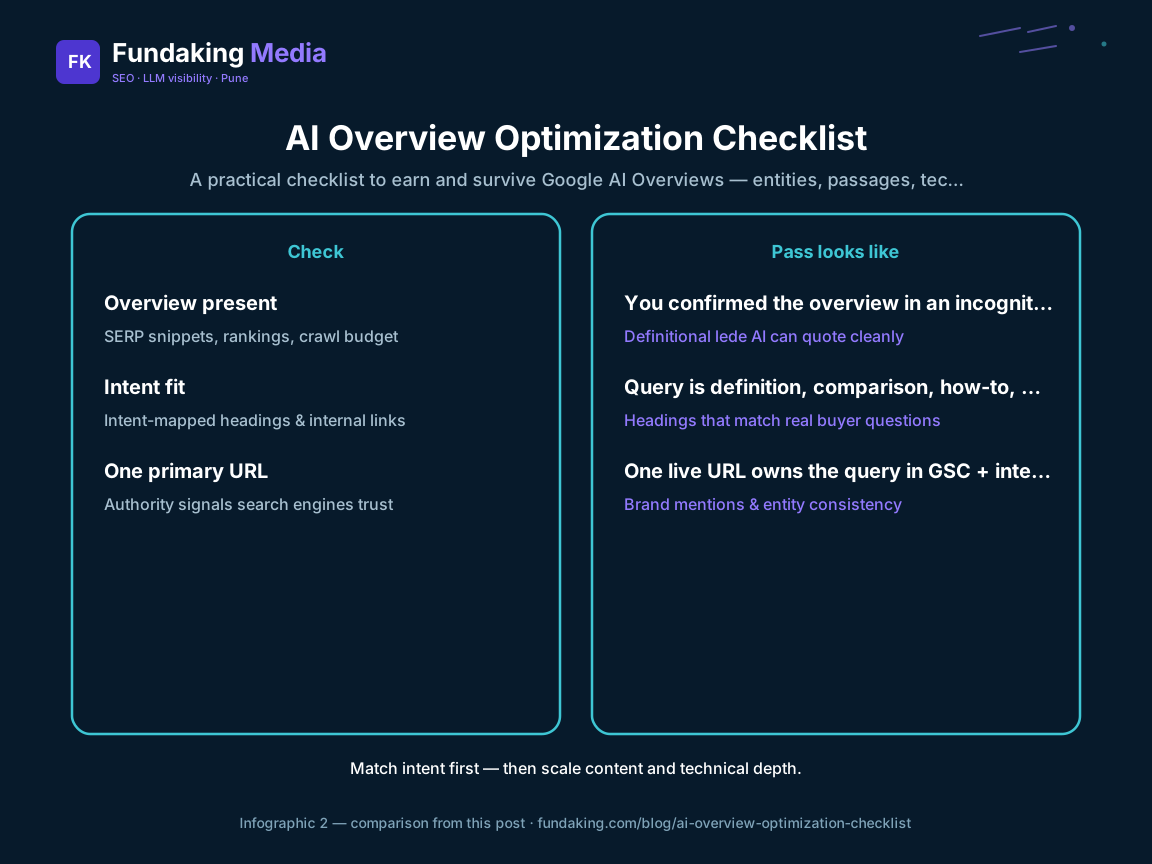
1. Query and SERP selection
| Check | Pass looks like | Fail looks like |
|---|---|---|
| Overview present | You confirmed the overview in an incognito (or clean-profile) check for India | You assume overviews from US screenshots or Twitter |
| Intent fit | Query is definition, comparison, how-to, or “best X for Y” that your product truly serves | You chase brand vanity queries or tiny-volume long tails |
| One primary URL | One live URL owns the query in GSC + internal linking | Three blogs and a thin service page fight each other |
| Click opportunity | Overview leaves a next-step (pricing, demo, implementation) or cites sources | Overview fully answers and your page has nothing deeper |
Action: Export 90 days of Search Console. Flag queries with high impressions and soft CTR. Manually verify overview presence. Write five rows: query → URL → screenshot date → named competitors in the overview.
2. Technical gates (non-negotiable)
If these fail, content polish will not matter.
- Primary URL returns 200 with no redirect chain longer than one hop
- URL is in the XML sitemap and not accidentally
noindex - Critical answer (definition, pricing band, location, integrations) exists in initial HTML — not only after client-side hydration
- Canonical points to the URL you want cited; no self-conflicting
hreflangor soft-404 - Core resources (CSS/JS that hide body text) are not blocked in robots
- Page is linked from a crawlable hub (category, cluster hub, or service page) — not an orphan
For JS-heavy stacks (Next.js, SPAs), compare view-source vs rendered DOM for the lede and FAQ. Models and classic crawlers still punish “answer only after hydration.” See Next.js SEO rendering and the technical SEO audit checklist.
3. Content and passage structure
AI Overviews pull quotable passages. Write for the extract, then for the human who clicks.
First screen (above the fold)
- First ~100–120 words state who it is for and what changes after reading
- Primary entity name (product, category, or service) appears in plain language — no clever metaphors only
- H1 matches the job of the page; it does not bait a different intent than the body
Scannable blocks assistants prefer
- At least one H2 phrased as a buyer question (the way people type, not “Introduction”)
- One table, numbered process, or checklist that can be lifted into a summary
- Short paragraphs; one idea per block
- Definitions use the category term + your brand term in the same sentence once (entity co-occurrence without stuffing)
Proof and freshness
- Claims with numbers are dated or scoped (India, SaaS, local service, sample size)
- At least one first-party proof link: case study, About, docs, or named process — not “trusted by 500 brands” with no names
- Stale BOFU claims (old pricing, discontinued features) are updated or removed
4. Entity and brand consistency
Overviews punish contradiction faster than they reward clever copy.
- Organization name matches sitewide, schema, and LinkedIn/GBP
- Founder / author name and role match About and Person/Organization schema
- Locations you claim (e.g. Pune / Baramati) appear the same way on contact, schema, and service pages
- Pricing, packaging, and “who we serve” do not disagree between blog, service page, and FAQ schema
- Same product category language as your money pages (do not invent a new niche name in the blog only)
If Google’s Knowledge Panel or brand SERP is messy, fix that before chasing overview citations — see brand knowledge panel entity cleanup.
5. Schema that matches the visible page
-
Article/BlogPosting(or relevant type) matches headline, dates, and author - FAQ schema only includes Q&As visible on the page
- Organization / LocalBusiness fields match NAP and About
- No leftover Product schema on a pure guide page (or vice versa)
Schema does not “unlock” AI Overviews. Mismatched schema does help you lose trust when models cross-check.
6. Internal links and commercial path
A citation without a path to revenue is a vanity win.
- This page links to the cluster hub: What Is AI SEO?
- Links to two sibling guides with descriptive anchors (not “click here”)
- One link to the matching service CTA — for this cluster, AI enablement or SEO consulting
- One proof link when you claim outcomes — e.g. Shubhshrey AI CRM case study
- Hub and service pages link back to this spoke where relevant
7. Measurement (what founders actually trust)
| Signal | How to track | Cadence |
|---|---|---|
| Overview presence | Screenshot library per query + date | Biweekly |
| Citation / brand mention in overview | Manual note: named / linked / absent | Biweekly |
| GSC CTR on overview queries | Query filter + landing page | Weekly |
| Assisted pipeline | Demo / WhatsApp / form from organic landing pages | Weekly |
| Entity health | Brand SERP + About facts | Monthly |
Do not buy a vanity “AI rank tracker” before you have this sheet. See measuring AI citations without vanity tools.
14-day sprint (one URL)
Days 1–2: Confirm overview + pick primary URL; dump technical fails.
Days 3–5: Rewrite lede, one question-H2, and one table or checklist; align FAQ to visible copy.
Days 6–7: Fix entity contradictions and schema mismatches.
Days 8–10: Wire hub ↔ spoke ↔ service ↔ proof links.
Days 11–12: Submit URL in GSC; request indexing if needed.
Days 13–14: Re-screenshot SERP; log CTR and whether your brand is named/linked.
Repeat for the next URL only after this one is Pass on technical + entity.
Common fails I see on Indian sites
- Five thin blogs for one overview query, none strong enough to cite
- Money page in React with the answer missing from raw HTML
- Agency reports full of keyword greenery while the overview cites a competitor’s comparison table
- FAQ schema that invents answers not on the page
- No BOFU path — great citation, zero demos
- Stale pricing on an old post poisoning summaries
When to bring in Fundaking
Bring senior help when your team can ship tickets but prioritization thrash weekly, or when JS rendering and entity cleanup block progress. I keep engagements founder-led from Pune / Baramati for teams across India. Start with AI enablement, SEO consulting, or book a call.
FAQ
Does optimizing for AI Overviews replace classic SEO?
No. Crawlability, intent match, and internal links still gate everything. Overviews add a passage-and-entity layer on top.
Should we publish more content to “feed” AI?
Only after the five battleground URLs pass this checklist. Volume without architecture dilutes topical authority.
Is this only for Pune businesses?
No. Operating base is Pune / Baramati; most work is remote across India. Local SEO matters when Maps intent is real — see the local SEO India playbook.
How do we know if an agency is doing this work?
Ask for the five-query sheet, screenshots, technical pass/fail on money URLs, and a before/after of the cited passage — not a keyword ranking PDF alone.
What is the fastest win?
Fix contradictory facts, put the answer in initial HTML, add one comparison table, and link hub ↔ spoke ↔ service.
Related reading on Fundaking
- What Is AI SEO? A Practical Definition for 2026
- Google AI Overviews: What Actually Moves the Needle
- Entity SEO for AI Overviews and Knowledge Panels
- AI enablement
- Shubhshrey AI CRM case study
Rahul Agarwal — Fundaking Media. SEO consultant based in Pune / Baramati, serving founders across India.
 Rahul Agarwal