

Build sitemaps that list money URLs, exclude junk, and stay in sync after migrations.
This article is written for engineering-aware founders and marketing leads who own crawl, index, and template quality. The outcome that matters is money URLs that load, resolve, and stay indexable without weekly fire drills. The failure mode I see weekly is shipping blog posts while product and category templates leak equity through redirects, bloat, and JS-only copy.
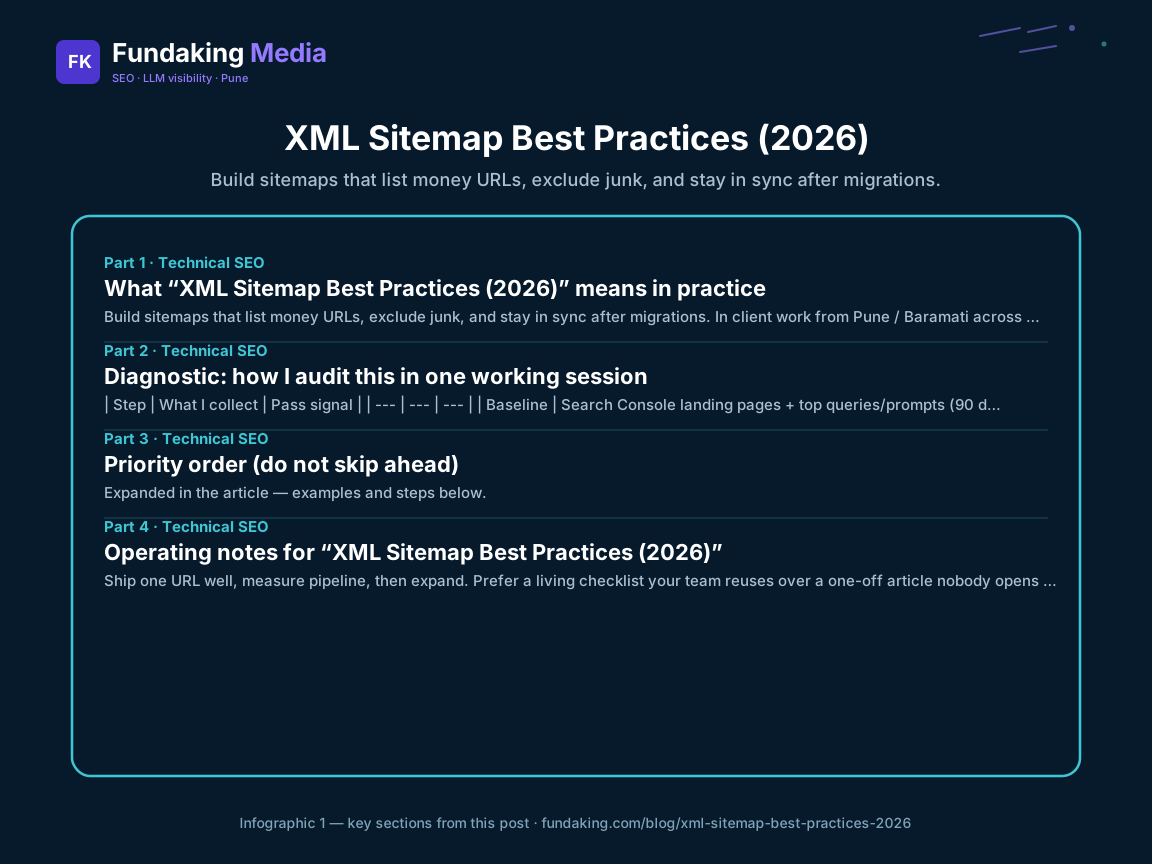
What “XML Sitemap Best Practices (2026)” means in practice
Build sitemaps that list money URLs, exclude junk, and stay in sync after migrations. In client work from Pune / Baramati across India, I treat this as a decision page: what breaks if we ignore it, what we ship in 30 days, and how we know it worked.
Ask three questions before tactics:
- Which revenue URL does this topic support (pricing, product, location, demo, service)?
- What would a sceptical buyer still doubt after reading?
- What will we measure in 30 days — demos, calls, WhatsApp leads, or qualified pipeline?
If those answers are vague, more paragraphs will not create topical authority. Fix the money URL and the measurement sheet first.
Diagnostic: how I audit this in one working session
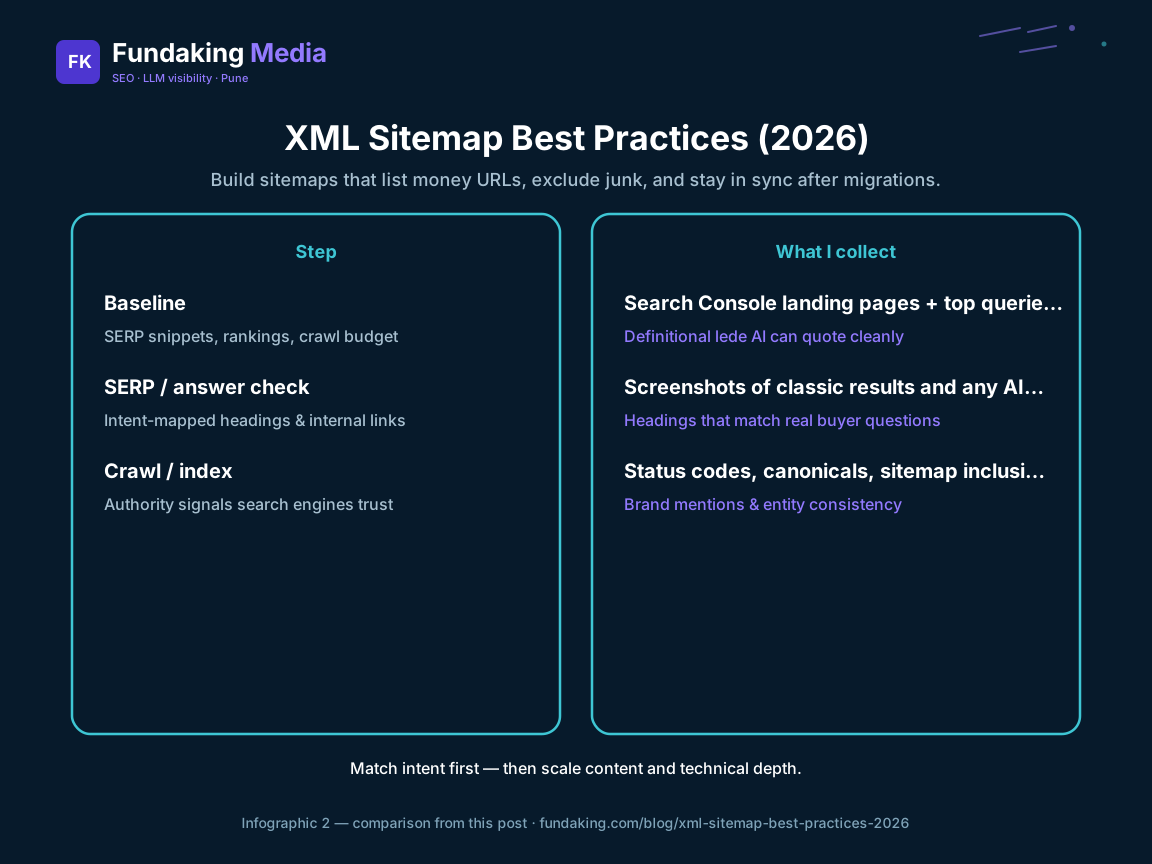
| Step | What I collect | Pass signal |
|---|---|---|
| Baseline | Search Console landing pages + top queries/prompts (90 days) | You can name five buyer intents |
| SERP / answer check | Screenshots of classic results and any AI overview | You know who currently wins |
| Crawl / index | Status codes, canonicals, sitemap inclusion on money URLs | Primary URLs return 200 and are indexable |
| Facts | Pricing, NAP, founder bio, offers across site + profiles | No contradictions |
| Path to revenue | Internal links from education → BOFU → CTA | One clear next step |
Bring this sheet into the same meeting where you review pipeline — not a separate “SEO theatre” call.
Priority order (do not skip ahead)
P0 — Technical and factual truth. Money pages must be crawlable, fast enough on mobile India networks, and factually aligned with schema and sales decks. Without this, content and citations rot.
P1 — One strong asset for “XML Sitemap Best Practices (2026)”. Rewrite or build a single page with a clear lede, a table or checklist, FAQ that matches visible copy, and proof. Prefer depth on one URL over five thin posts.
P2 — Cluster wiring. Link hub ↔ this spoke ↔ siblings ↔ Technical SEO consulting ↔ Fintech organic growth case study. Anchors should name the destination topic.
P3 — Measurement. Track qualified enquiries and a simple visibility log. Rankings alone are a lagging vanity metric.
Operating notes for “XML Sitemap Best Practices (2026)”
Ship one URL well, measure pipeline, then expand. Prefer a living checklist your team reuses over a one-off article nobody opens after publish. When you outgrow DIY prioritisation, Technical SEO consulting is scoped so strategy stays founder-led from Pune / Baramati.
Implementation checklist you can copy
Content
- 30-day workflow for a small team
- Mistakes that waste a quarter
- How this maps to Fundaking work
- Field playbook: applying this with one marketer
- FAQ
- Related reading on Fundaking
Technical
- Canonical 200 on the target URL; listed in XML sitemap; no accidental noindex
- Critical definitions present in initial HTML (not only after hydration)
- No redirect chains or soft-404s on revenue templates
- Internal links from three existing relevant URLs into this page
Commercial
- CTA matches intent (audit call vs Maps setup vs AI enablement vs technical fix)
- Proof link to a real case study when claims get specific
- Sales can forward this URL after a call without apology
30-day workflow for a small team
Week 1 — Baseline. Export GSC; list five buyer queries or prompts tied to “XML Sitemap Best Practices (2026)”; screenshot SERPs; list P0 defects on the revenue URL.
Week 2 — Fix facts and crawl. Align NAP, pricing, and founder bio. Ship engineering tickets with acceptance criteria (status code, visible copy, schema match).
Week 3 — Ship the asset. Publish or rewrite the primary page. Add the table/checklist. Wire hub and service links.
Week 4 — Measure and decide. Log demos/calls. Re-check SERP or AI screenshots. Decide: continue DIY, add advisory, or pause volume until P0 is green.
Mistakes that waste a quarter
- Publishing more blogs while money URLs are uncrawlable or contradictory
- Chasing tactics from threads without a Search Console baseline
- Treating AI visibility, local Maps, and technical SEO as unrelated silos
- Skipping internal links from education posts to BOFU pages
- Measuring rankings alone instead of qualified enquiries
- Letting agencies deliver keyword greenery while the founder never sees the five-query sheet
How this maps to Fundaking work
If your team can execute tickets, start with a scoped audit and roadmap. If priorities thrash weekly, use monthly advisory so the same strategist who diagnoses stays in the loop. That is how Technical SEO consulting is scoped from Pune / Baramati for India and remote teams.
When claims need proof, point to Fintech organic growth case study. Category focus for this article: Technical SEO.
Field playbook: applying this with one marketer
Indian founding teams usually have one marketer wearing five hats. You cannot boil the ocean. Pick the single revenue URL this article supports, fix crawl and facts first, then ship one scannable asset sales can send after a call.
Use a shared Sheet with: URL, owner, due date, status, KPI. Review it in the pipeline meeting. If engineering is blocked, write the ticket with acceptance criteria so the PR can be reviewed without another discovery call.
FAQ
Is this only for Pune?
No — Pune / Baramati is the operating base; most work is remote across India. Local proof helps services businesses; national category SEO still dominates for most SaaS.
Do we need more content first?
Only after money URLs are crawlable, factual, and linked from the cluster. Volume without architecture dilutes topical authority.
How does AI search change this?
Classic technical quality and entity clarity still gate citations. See What Is AI SEO? and the AI Overview optimization checklist.
When should we hire help?
When engineering bandwidth exists but prioritisation is missing — or when migrations, JS rendering, or multi-location structure block progress. Book a call if you want a second opinion on scope.
What is the fastest win?
Fix contradictory facts, improve one BOFU page tied to “XML Sitemap Best Practices (2026)”, and add hub ↔ spoke ↔ service links. Then expand depth.
Related reading on Fundaking
- Technical SEO Audit Checklist (2026)
- Canonical Tags: Common Mistakes That Kill Rankings
- Site Migration SEO Checklist
- Technical SEO consulting
- Fintech organic growth case study
Rahul Agarwal — Fundaking Media. SEO consultant based in Pune / Baramati, serving founders across India.
 Rahul Agarwal