

Indian coaching and edtech sites usually fail SEO the same way: a homepage promise, a thin “courses” dump, and blog posts that never touch the money URLs. Parents and working professionals search for outcomes — exam names, batch cities, fee clarity, faculty proof — not “innovative learning ecosystem.”
This spoke sits under the SEO consultant in Pune founder’s guide. Pair it with content cluster strategy for B2B India when you need the architecture, not more articles.
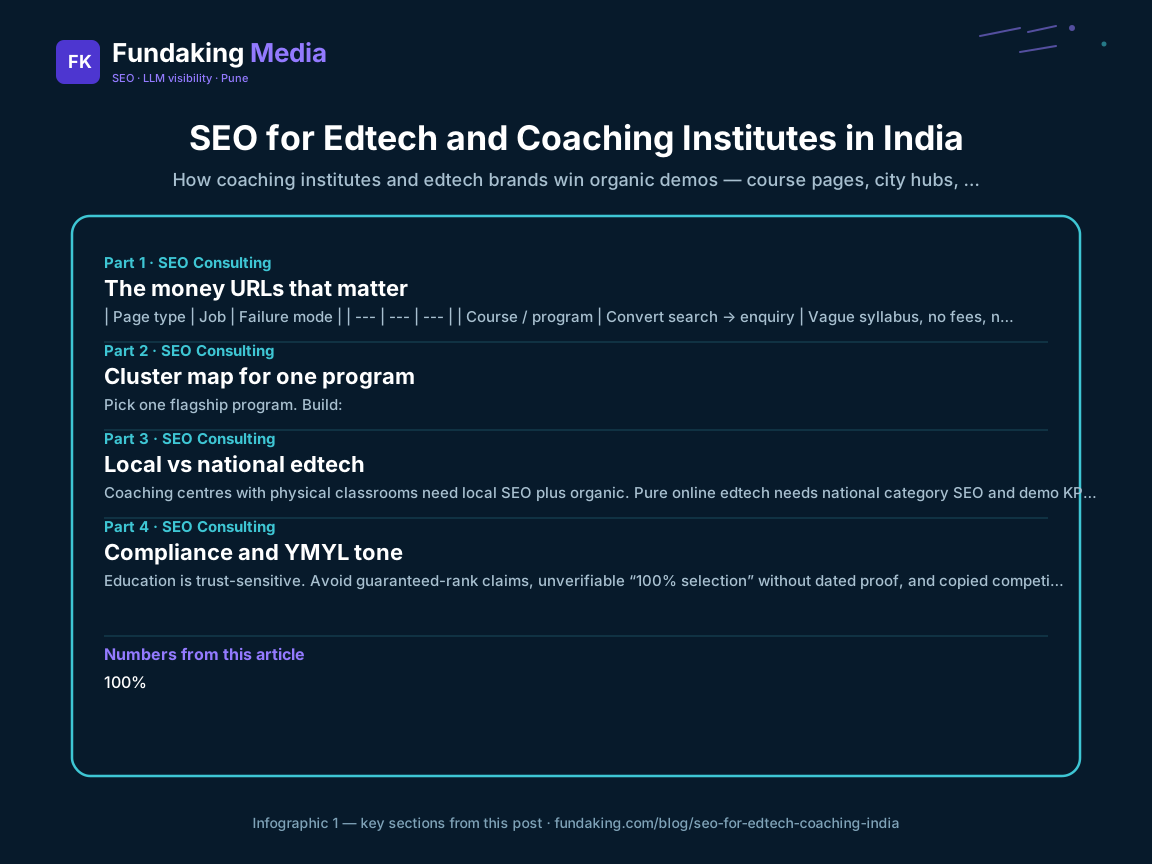
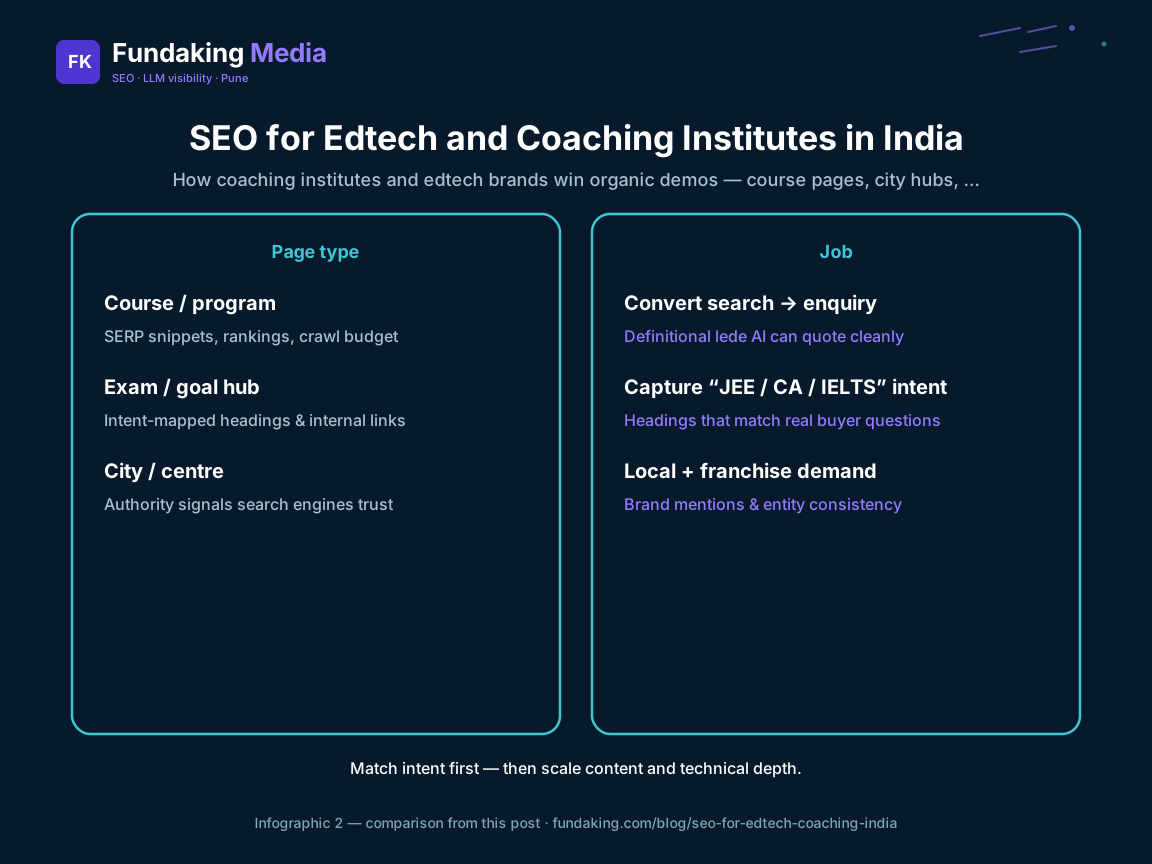
The money URLs that matter
| Page type | Job | Failure mode |
|---|---|---|
| Course / program | Convert search → enquiry | Vague syllabus, no fees, no next batch |
| Exam / goal hub | Capture “JEE / CA / IELTS” intent | Thin doorway pages |
| City / centre | Local + franchise demand | Duplicate NAP, fake addresses |
| Comparison / vs | Steal mid-funnel | Sales fluff without table |
| Faculty / results | Trust | Unverifiable claims |
If those five templates are weak, publishing “10 tips for students” will not create topical authority.
Cluster map for one program
Pick one flagship program. Build:
- Program page (BOFU) with fees band, eligibility, duration, CTA
- Two supporting explainers (syllabus depth, who it is for)
- One comparison (vs competitor or vs self-study)
- FAQ block that matches sales objections
- Internal links from blog → program → contact / WhatsApp
Then expand to the next program. Volume without this spine dilutes crawl and trust.
Local vs national edtech
Coaching centres with physical classrooms need local SEO plus organic. Pure online edtech needs national category SEO and demo KPIs — see SEO roadmap for SaaS founders. Do not force Maps strategies onto a pan-India LMS.
Compliance and YMYL tone
Education is trust-sensitive. Avoid guaranteed-rank claims, unverifiable “100% selection” without dated proof, and copied competitor faculty bios. Align About, Organization schema, and course pages. Assistants punish contradiction faster than Google alone.
30-day sprint
Week 1: Inventory programs; pick one money URL; fix indexation and title.
Week 2: Rewrite program page + FAQ; add comparison table.
Week 3: Wire three existing posts to that URL; add GBP if you have a centre.
Week 4: Measure enquiries / demo form completes — not only rankings.
FAQ
Do we need a blog? Only after money URLs convert. Blogs support hubs; they are not the product.
City pages for every centre? Yes if NAP is real and unique. No if they are spun templates.
What should we hire for? Strategy + technical floor + program-page copy — via SEO consulting. Proof pattern: SaaS demo requests case study.
Related reading on Fundaking
- SEO Consultant in Pune: A Founder’s Guide (2026)
- Content Cluster Strategy for B2B in India
- SEO Consultant in Pune: A Founder’s Guide (2026)
- SEO for Funded Startups in India (Post-PMF)
- SEO consulting services
- SaaS demo requests case study
Rahul Agarwal — Fundaking Media. SEO consultant based in Pune / Baramati, serving founders across India.
 Rahul Agarwal