

Sales calls are the highest-signal “keyword research” most Indian SaaS and service teams ignore. Prospects already tell you the comparisons, objections, and phrasing they type into Google or paste into ChatGPT. This guide shows how I turn call notes into a prompt/query library that feeds AI SEO and classic content — without buying another research tool.
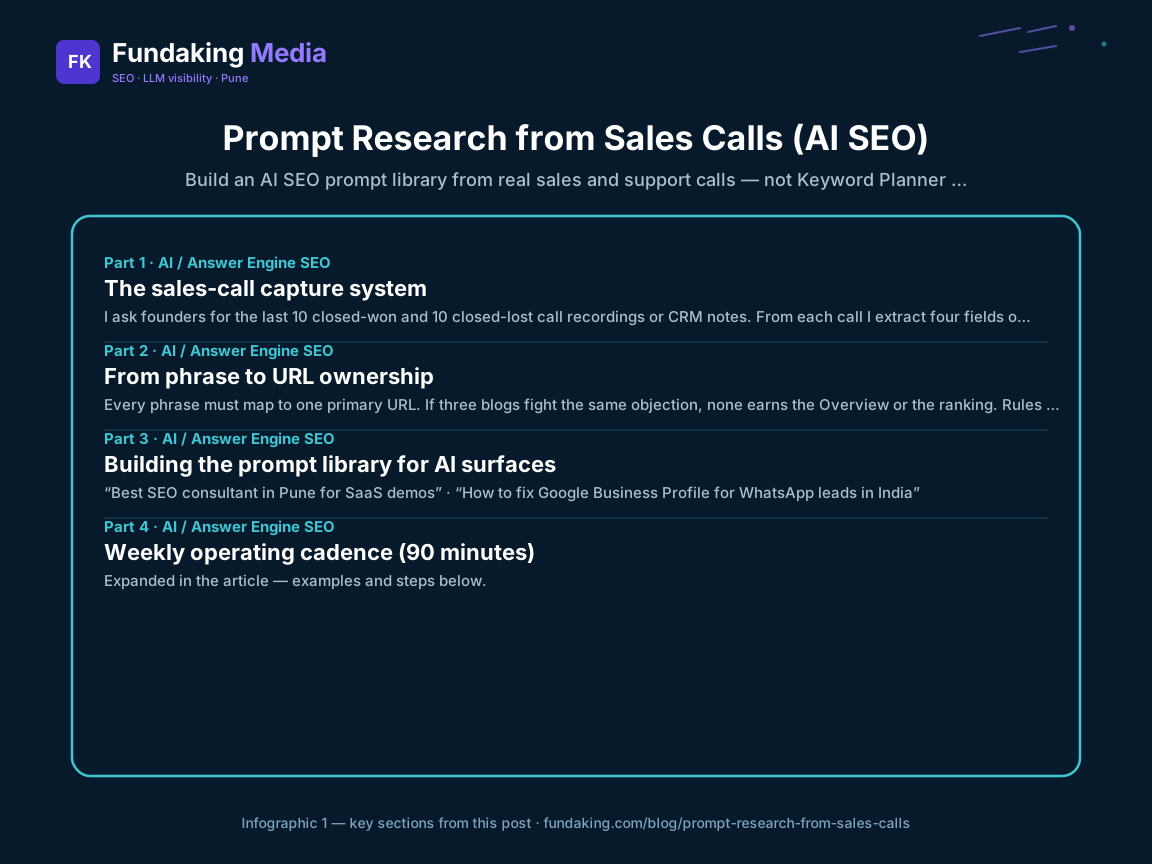
The sales-call capture system
I ask founders for the last 10 closed-won and 10 closed-lost call recordings or CRM notes. From each call I extract four fields only:
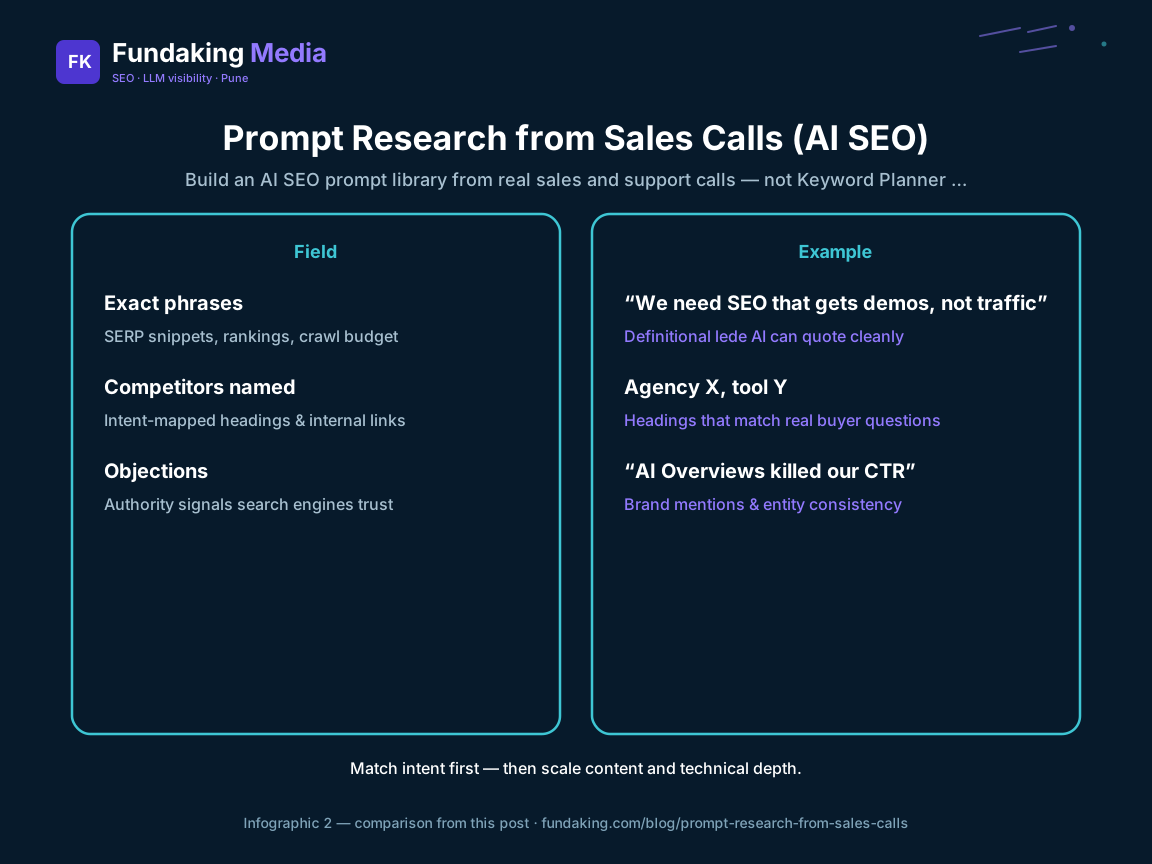
| Field | Example | Why it matters |
|---|---|---|
| Exact phrases | “We need SEO that gets demos, not traffic” | Becomes H2 / FAQ language |
| Competitors named | Agency X, tool Y | Fuels comparison pages |
| Objections | “AI Overviews killed our CTR” | Becomes educational spokes |
| Desired outcome | “WhatsApp leads from Maps” | Ties content to revenue |
Store these in a shared Sheet: date, segment (SaaS / local / D2C), phrase, mapped URL, owner, status. Review it in the same weekly meeting as pipeline — not a separate SEO call.
From phrase to URL ownership
Every phrase must map to one primary URL. If three blogs fight the same objection, none earns the Overview or the ranking. Rules I use:
- Money intent (pricing, vs, implementation) → service or pricing URL
- Definition / how-to → one cluster spoke
- Local / city → city or service-area page
- If no URL fits, create one — do not bolt the phrase onto an unrelated post
Building the prompt library for AI surfaces
For AI Overviews and assistants, rephrase each sales phrase as a buyer prompt:
- “Best SEO consultant in Pune for SaaS demos”
- “How to fix Google Business Profile for WhatsApp leads in India”
- “Shopify collection filters hurting SEO — what to do”
Then screenshot who currently wins the Overview or the classic SERP. That becomes the battleground list for the AI Overview optimization checklist.
Weekly operating cadence (90 minutes)
Minutes 0–20: Pull new call notes; add phrases.
Minutes 20–40: Map unmapped phrases to URLs; flag orphans.
Minutes 40–70: Ship one lede/FAQ rewrite on the highest-volume phrase.
Minutes 70–90: Log CTR / demos from that URL; update status.
Mistakes that waste the research
- Collecting phrases but never changing on-page copy
- Letting SDRs invent jargon that buyers never type
- Building 20 blogs from one call instead of fixing one BOFU page
- Ignoring lost-deal language (often richer than wins)
How Fundaking uses this with clients
In SEO consulting and AI enablement engagements, the prompt library is a deliverable — not a slide. It connects sales language to crawlable HTML and, when ops are the bottleneck, to CRM automation as in the Shubhshrey AI CRM case study.
FAQ
Do we need call recordings or are CRM notes enough?
Notes work if they capture exact buyer language. Recordings are better for nuance.
How many phrases before we start publishing?
Start after 15–20 mapped phrases. Volume without URL ownership creates orphans.
Does this replace keyword tools?
It complements them. Tools show volume; calls show revenue language.
What if sales refuses to share calls?
Sit in two demos yourself. One afternoon beats a month of guesswork.
Where do prompts go next?
Into the five-query Overview sheet and into FAQ blocks that match visible copy.
Call tagging taxonomy I actually use
I tag every extracted phrase with one of: problem, comparison, pricing, implementation, trust, or local. Problem phrases become hub/spoke education. Comparison and pricing become BOFU pages. Trust phrases feed About, case studies, and review asks. Local phrases feed GBP and city pages.
Without taxonomy, teams dump everything into the blog and wonder why demos do not move. Taxonomy forces URL ownership.
Example: SaaS discovery call → three assets
Prospect says: “We tried an agency for a year, got traffic, zero demos, and now AI Overviews stole our head terms.”
Mapped assets:
- Service page lede updated to “demos, not traffic” language
- Spoke on AI Overview CTR diagnosis linking to the checklist
- Case study proof block on qualified pipeline
That is three ships from one sentence — not thirty thin posts.
Objection library for India SaaS
Recurring objections I hear in Pune and remote India calls: agency theatre, “SEO takes forever,” paid ads dependency, engineering bandwidth, fear of AI zero-click. Each objection gets a living FAQ answer on the money URL and a longer spoke only if the FAQ cannot hold the nuance.
CRM fields that make this durable
Add optional fields: seo_phrases, competitors_mentioned, primary_objection. SDRs need a 10-second habit, not a novel. Review weekly with marketing.
What “done” looks like after 60 days
- 40+ mapped phrases with owners
- Five battleground URLs rewritten with sales language in the first screen
- Prompt/Overview sheet updated biweekly
- At least one closed-won deal where the buyer quoted your page language back
If those four are missing, you are collecting folklore, not running research.
Go-to-market plays built on “Prompt Research from Sales Calls (AI SEO)”
Solo marketer path
You have ten hours a week. For “Prompt Research from Sales Calls (AI SEO)”, pick one revenue URL this topic supports, write acceptance criteria for engineering (status code, visible copy, schema match), and ship a single scannable asset sales can forward after a call. Refuse new blog ideas until that URL is green in Search Console and linked from your cluster hub.
Track work in a Sheet with columns: URL, owner, due date, status, KPI (demos, calls, WhatsApp, or qualified pipeline). Review it in the pipeline meeting — not a separate SEO theatre call.
Already-have-an-agency path
Use this article as a scorecard. Ask for evidence that the checks here are done on your money URLs. If the agency only returns keyword greenery, escalate once with a written 14-day recovery plan. If they cannot speak to the substance of “Prompt Research from Sales Calls (AI SEO)”, change the operating model.
Scaling-content path
Volume is not the strategy. Gate every new outline on: which prompt or query it supports, which URL owns it, and which demo stage it influences. “Prompt Research from Sales Calls (AI SEO)” should appear in the quarterly roadmap with a named owner and a kill criterion if pipeline does not move.
Answer-engine QA gates for “Prompt Research from Sales Calls (AI SEO)”
Discovery
- Five buyer prompts or queries documented from sales or support
- Primary URL chosen; competing URLs listed for consolidation
- Screenshot baseline of SERP / Maps / AI answer dated
Execution
- Technical gates on the primary URL pass (200, indexable, facts in HTML)
- First screen rewritten in buyer language, not internal jargon
- At least one table, process list, or FAQ block that can be quoted
- Hub ↔ spoke ↔ service ↔ proof links with descriptive anchors
Proof and QA
- Claims with numbers are dated or scoped to India / segment
- Organization and author facts match About and schema
- Sales reviewed the page and would send it to a prospect
Measurement
- KPI tile exists on the founder dashboard
- Biweekly or weekly review assigned
- Decision logged after 30 days: double down, fix, or cut
Pushbacks I hear on “Prompt Research from Sales Calls (AI SEO)”
“We need more content first.”
Not if money URLs fail crawl or contradict pricing. Volume without architecture dilutes topical authority and wastes writers.
“Our agency said rankings are up.”
Ask for demos and the five-query sheet. Rankings without pipeline are a vanity report.
“AI will handle this automatically.”
Models amplify whatever facts you publish. Wrong NAP, wrong pricing, and JS-only answers get amplified too.
“We are too early for SEO.”
You are not too early for clean money URLs and entity facts. You may be too early for a large content team — that is different.
Calendar — first 45 days on “Prompt Research from Sales Calls (AI SEO)”
Days 1–5: Baseline data, choose primary URL, list P0 defects.
Days 6–15: Ship technical and factual fixes; rewrite lede + FAQ.
Days 16–30: Wire internal links; update service CTA; brief sales.
Days 31–45: Measure; screenshot again; decide next URL. Do not start URL #2 until URL #1 is honestly Pass on technical + entity checks.
Working with Fundaking on “Prompt Research from Sales Calls (AI SEO)”
Scoped audit and roadmap when your team can execute tickets. Monthly advisory when priorities thrash. Hybrid is common: I prioritise and QA; your marketer and eng ship. Work runs from Pune / Baramati across India and remote teams. Start via the matching service page linked in Related reading, or book a call.
FAQ — implementation details for “Prompt Research from Sales Calls (AI SEO)”
Does this replace the cluster hub article?
No — this spoke implements one job; the hub frames the pillar.
How do we keep pages from going stale?
Revisit when pricing, packaging, or service area changes. Stale BOFU claims are worse than thin TOFU posts.
What is the minimum evidence for case-study claims?
Named process and scoped outcomes you can defend on a sales call — not invented percentages.
Should every blog have the same CTA?
No. Match intent: Maps/WhatsApp for local, demo for SaaS, audit call for consulting.
When is “Prompt Research from Sales Calls (AI SEO)” not P0?
When crawl/index on revenue templates is broken, or when ops cannot handle leads. Fix those constraints first.
Related reading on Fundaking
- What Is AI SEO? A Practical Definition for 2026
- Running a Prompt Library Workshop with Your SEO Team
- Conversational Query Mapping for LLM SEO
- AI enablement
- Shubhshrey AI CRM case study
Rahul Agarwal — Fundaking Media. SEO consultant based in Pune / Baramati, serving founders across India.
 Rahul Agarwal