

A messy brand SERP and Knowledge Panel quietly poison AI answers and classic trust. This is the cleanup playbook I run before scaling content for Indian brands — especially when Google shows the wrong industry, old address, or a namesake conflict.
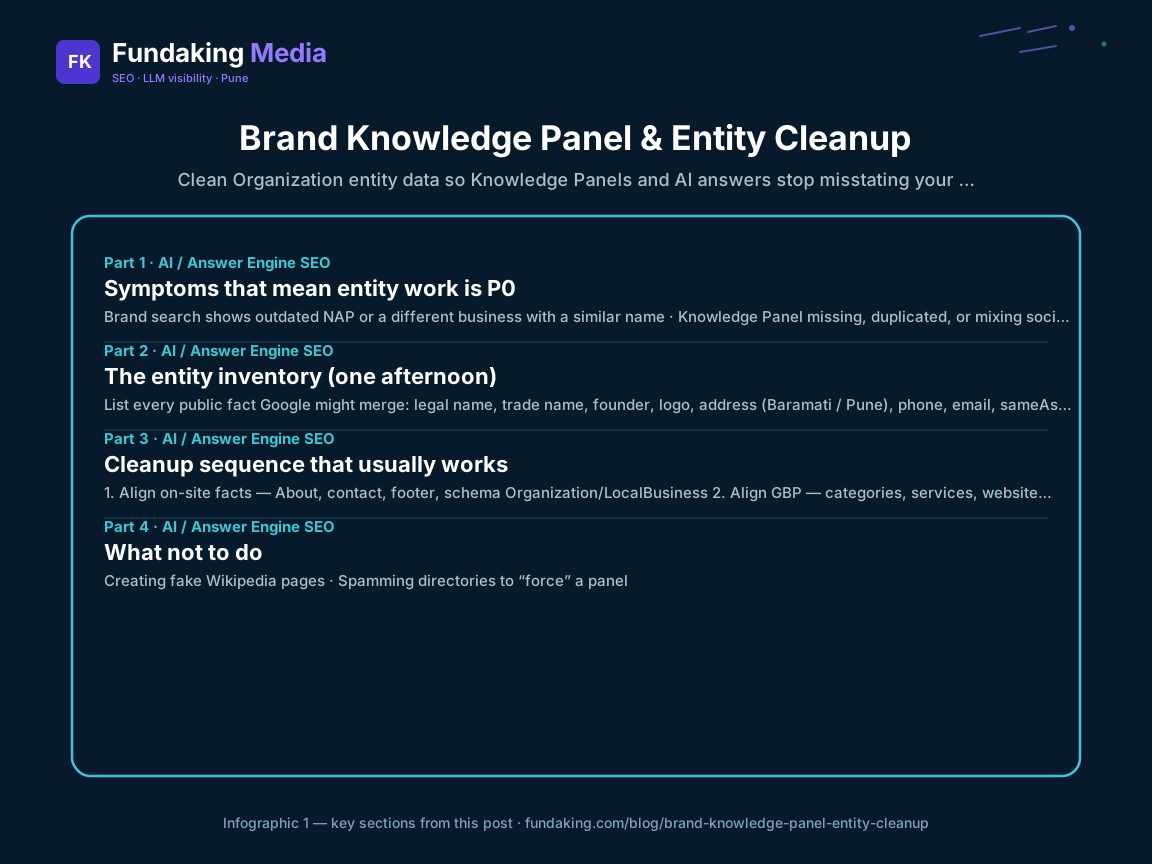
Symptoms that mean entity work is P0
- Brand search shows outdated NAP or a different business with a similar name
- Knowledge Panel missing, duplicated, or mixing social profiles
- AI Overviews invent founder names, cities, or offers
- Organization schema disagrees with the About page
If any two are true, pause vanity blogging and fix the entity.
The entity inventory (one afternoon)
List every public fact Google might merge: legal name, trade name, founder, logo, address (Baramati / Pune), phone, email, sameAs profiles, categories. Diff that list against: homepage, About, contact, GBP, LinkedIn, schema JSON-LD, and top five blogs.
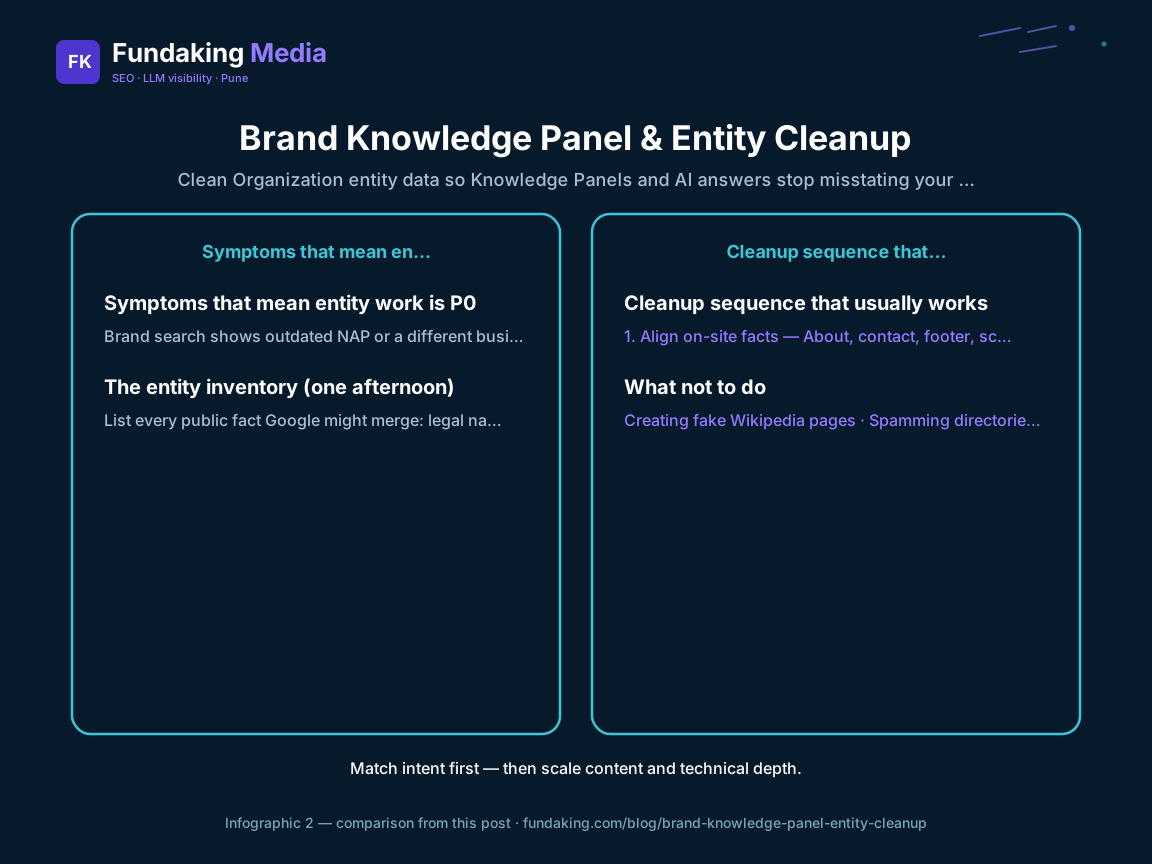
Cleanup sequence that usually works
- Align on-site facts — About, contact, footer, schema Organization/LocalBusiness
- Align GBP — categories, services, website URL, hours
- sameAs hygiene — LinkedIn, Maps place URL, review URL; drop dead profiles
- Disambiguation content — clear “who we are / who we are not” on About
- Request updates where Google provides UI; document screenshots
- Re-check brand SERP weekly for 4–6 weeks
Deep companion: Entity SEO for AI Overviews.
What not to do
- Creating fake Wikipedia pages
- Spamming directories to “force” a panel
- Changing the brand name every quarter
- Leaving old .php URLs with conflicting NAP in the index
How this ties to Fundaking services
Entity cleanup is usually a workstream inside SEO consulting or local SEO when Maps and brand search both matter. For AI-heavy teams, pair with AI enablement so CRM facts match the public entity.
FAQ
Do we need a Knowledge Panel to rank?
No — but a wrong panel actively hurts trust and AI summaries.
How long does cleanup take?
On-site fixes are days; Google’s reflection can take weeks.
What if another company shares our name?
Strengthen NAP + founder + category co-occurrence; consider a clearer trade name in titles.
Is schema enough?
Schema helps consistency; it does not override contradictory visible copy.
Where do we start?
About + Organization schema + brand SERP screenshots this week.
Namesake and category collision playbook
If Google merges you with another firm:
- Strengthen unique identifiers (founder full name, distinctive trade name, exact address)
- Publish a clear About disambiguation paragraph
- Align logo consistently across GBP and LinkedIn
- Avoid abbreviated names that collide
- Document evidence for support requests
Social profile hygiene
sameAs should list living profiles only. Dead Facebook pages and old Clutch profiles with wrong NAP hurt more than they help. Prefer LinkedIn company + founder + Maps place URL.
After a rebrand or office move
Treat it like a migration: update site + schema day 0, GBP day 0, directories within 7 days, monitor brand SERP for 6 weeks. Keep 301s from old trademark URLs if they had equity.
Measuring entity health
Monthly brand SERP screenshot, Knowledge Panel field checklist, and a spot-check of three AI prompts containing your brand name for hallucinated facts.
Go-to-market plays built on “Brand Knowledge Panel & Entity Cleanup”
Solo marketer path
You have ten hours a week. For “Brand Knowledge Panel & Entity Cleanup”, pick one revenue URL this topic supports, write acceptance criteria for engineering (status code, visible copy, schema match), and ship a single scannable asset sales can forward after a call. Refuse new blog ideas until that URL is green in Search Console and linked from your cluster hub.
Track work in a Sheet with columns: URL, owner, due date, status, KPI (demos, calls, WhatsApp, or qualified pipeline). Review it in the pipeline meeting — not a separate SEO theatre call.
Already-have-an-agency path
Use this article as a scorecard. Ask for evidence that the checks here are done on your money URLs. If the agency only returns keyword greenery, escalate once with a written 14-day recovery plan. If they cannot speak to the substance of “Brand Knowledge Panel & Entity Cleanup”, change the operating model.
Scaling-content path
Volume is not the strategy. Gate every new outline on: which prompt or query it supports, which URL owns it, and which demo stage it influences. “Brand Knowledge Panel & Entity Cleanup” should appear in the quarterly roadmap with a named owner and a kill criterion if pipeline does not move.
Answer-engine QA gates for “Brand Knowledge Panel & Entity Cleanup”
Discovery
- Five buyer prompts or queries documented from sales or support
- Primary URL chosen; competing URLs listed for consolidation
- Screenshot baseline of SERP / Maps / AI answer dated
Execution
- Technical gates on the primary URL pass (200, indexable, facts in HTML)
- First screen rewritten in buyer language, not internal jargon
- At least one table, process list, or FAQ block that can be quoted
- Hub ↔ spoke ↔ service ↔ proof links with descriptive anchors
Proof and QA
- Claims with numbers are dated or scoped to India / segment
- Organization and author facts match About and schema
- Sales reviewed the page and would send it to a prospect
Measurement
- KPI tile exists on the founder dashboard
- Biweekly or weekly review assigned
- Decision logged after 30 days: double down, fix, or cut
Pushbacks I hear on “Brand Knowledge Panel & Entity Cleanup”
“We need more content first.”
Not if money URLs fail crawl or contradict pricing. Volume without architecture dilutes topical authority and wastes writers.
“Our agency said rankings are up.”
Ask for demos and the five-query sheet. Rankings without pipeline are a vanity report.
“AI will handle this automatically.”
Models amplify whatever facts you publish. Wrong NAP, wrong pricing, and JS-only answers get amplified too.
“We are too early for SEO.”
You are not too early for clean money URLs and entity facts. You may be too early for a large content team — that is different.
Calendar — first 45 days on “Brand Knowledge Panel & Entity Cleanup”
Days 1–5: Baseline data, choose primary URL, list P0 defects.
Days 6–15: Ship technical and factual fixes; rewrite lede + FAQ.
Days 16–30: Wire internal links; update service CTA; brief sales.
Days 31–45: Measure; screenshot again; decide next URL. Do not start URL #2 until URL #1 is honestly Pass on technical + entity checks.
Working with Fundaking on “Brand Knowledge Panel & Entity Cleanup”
Scoped audit and roadmap when your team can execute tickets. Monthly advisory when priorities thrash. Hybrid is common: I prioritise and QA; your marketer and eng ship. Work runs from Pune / Baramati across India and remote teams. Start via the matching service page linked in Related reading, or book a call.
FAQ — implementation details for “Brand Knowledge Panel & Entity Cleanup”
Does this replace the cluster hub article?
No — this spoke implements one job; the hub frames the pillar.
How do we keep pages from going stale?
Revisit when pricing, packaging, or service area changes. Stale BOFU claims are worse than thin TOFU posts.
What is the minimum evidence for case-study claims?
Named process and scoped outcomes you can defend on a sales call — not invented percentages.
Should every blog have the same CTA?
No. Match intent: Maps/WhatsApp for local, demo for SaaS, audit call for consulting.
When is “Brand Knowledge Panel & Entity Cleanup” not P0?
When crawl/index on revenue templates is broken, or when ops cannot handle leads. Fix those constraints first.
Related reading on Fundaking
- What Is AI SEO? A Practical Definition for 2026
- Entity SEO for AI Overviews and Knowledge Panels
- When AI Gets Your Brand Wrong: A Fix Playbook
- AI enablement
- Shubhshrey AI CRM case study
Rahul Agarwal — Fundaking Media. SEO consultant based in Pune / Baramati, serving founders across India.
 Rahul Agarwal