

Many crawlers execute limited JavaScript. If your pricing table mounts after hydration, retrieval may index an empty shell.
Mitigations:
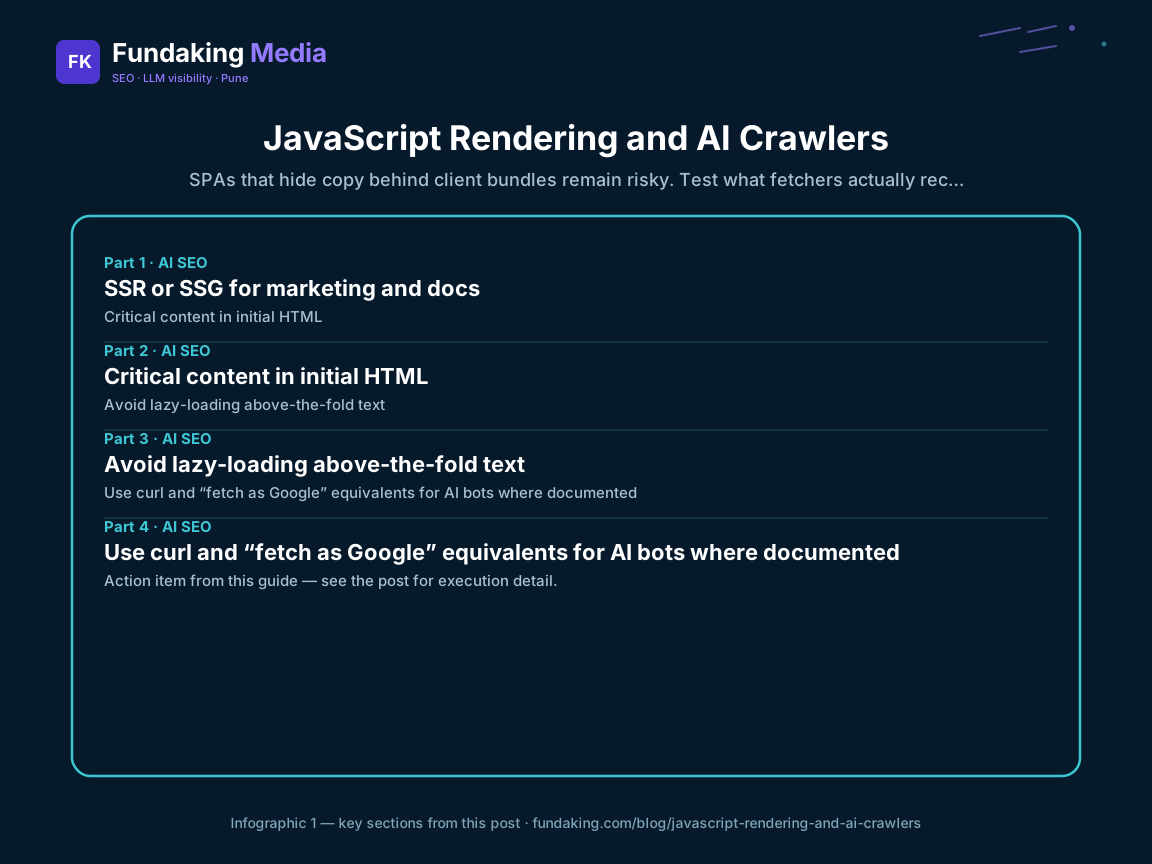
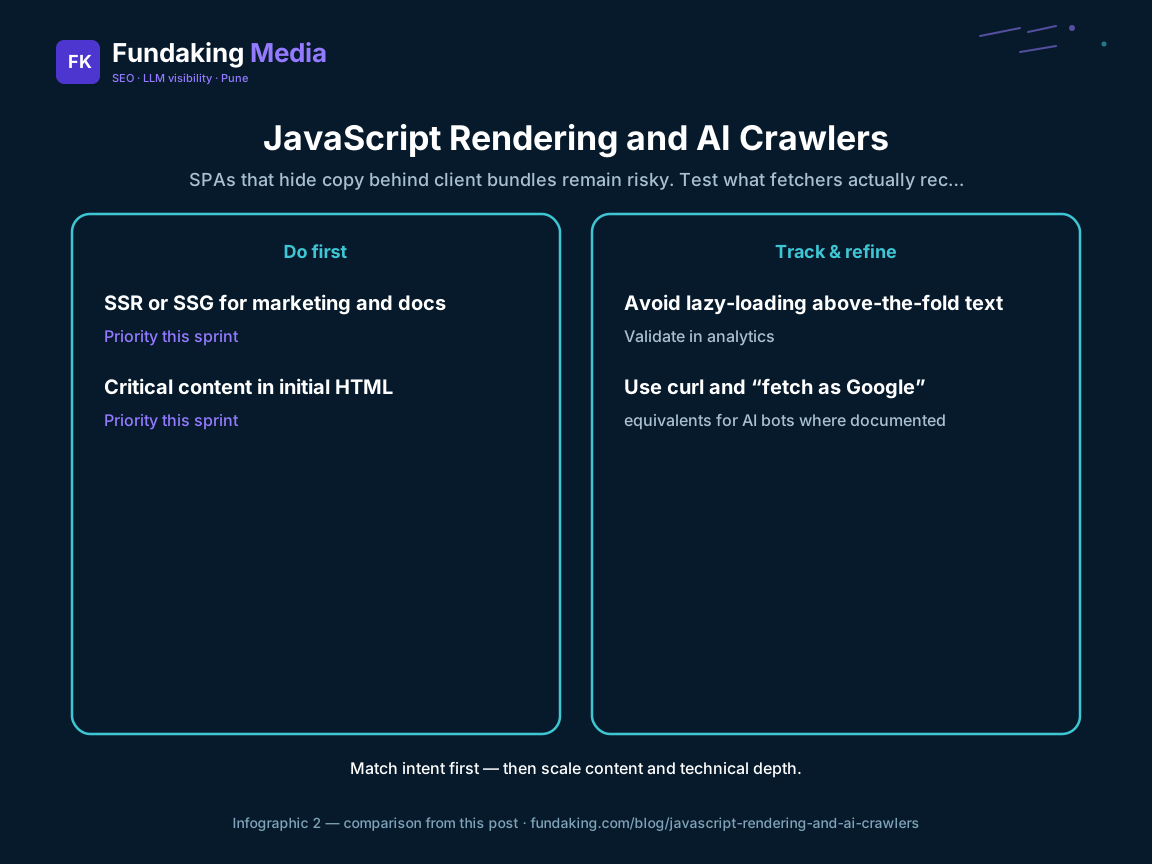
- SSR or SSG for marketing and docs
- Critical content in initial HTML
- Avoid lazy-loading above-the-fold text
- Use
curland “fetch as Google” equivalents for AI bots where documented
Compare rendered DOM vs view-source on template pages quarterly.
Why founders should care now
SPAs that hide copy behind client bundles remain risky. Test what fetchers actually receive in raw HTML. That is not theory for me — it shows up on discovery calls when organic pipeline stalls or when AI answers describe a competitor instead of your brand. Search and answer engines reward specific, verifiable pages, not generic SEO filler.
If you are evaluating priorities, ask whether this topic touches revenue pages (pricing, product, comparisons) or trust pages (about, case studies, docs). Fix trust and structure before you scale content volume.
Mistakes I see on live sites
- Chasing tactics from Twitter threads without a baseline audit in Search Console and analytics.
- Publishing more blogs when the root issue is indexation, faceted URLs, or slow LCP on money pages.
- Treating AI visibility as separate from technical SEO — crawlers and models both need clean HTML and consistent facts.
- Skipping internal links from new posts to BOFU pages, so traffic lands nowhere useful.
A 30-day workflow you can run in-house
Week 1 — Baseline: Export top landing pages by impressions, list five prompts or queries buyers actually use, screenshot current AI/search results for your brand.
Week 2 — Fix facts: Align pricing, integrations, and founder bio across site, GBP, and LinkedIn. One wrong number in an old blog comment can poison summaries.
Week 3 — Ship one asset: Pick a single page tied to “JavaScript Rendering and AI Crawlers” and rewrite the lede, add a comparison table or checklist, improve internal links.
Week 4 — Measure: Track qualified leads or demo requests from organic — not rank positions alone. Re-run your prompt library and log citation changes.
When to bring in a consultant
Bring in senior help when engineering bandwidth exists but prioritization is missing — or when migrations, JavaScript rendering, or international structure block progress. I cap Fundaking engagements so strategy stays founder-led; book a call if you want a second opinion on scope.
Category focus for this article: AI SEO.
Deep dive: applying “JavaScript Rendering and AI Crawlers” on a real site
When I audit a site for this topic, I start with crawl stats and Search Console landing pages — not a keyword export. I want to see which URLs already earn impressions and whether the title and H1 promise the same thing. Misalignment here is the silent killer for both classic rankings and AI citations.
Technical checks I run first
- Confirm money pages return 200 without redirect chains and appear in the XML sitemap.
- Compare rendered HTML vs view-source for key definitions (pricing, integrations, locations).
- Validate Organization, WebSite, and Article or BlogPosting schema against visible copy.
- Review internal links: every new blog should point to at least one service page and one proof page (case study or about).
Content checks
- Does the first screen answer who this is for and what changes after reading?
- Are claims dated or sourced when you mention benchmarks or percentages?
- Is there a downloadable or scannable asset (checklist, table) assistants can quote?
Measurement
Track branded search lift, assisted conversions from blog landing pages, and a simple prompt/citation log if you care about LLM visibility. Rankings alone are a lagging indicator; pipeline is the decision metric.
If you want help prioritizing, contact Fundaking for a free strategy call — I will tell you if this topic needs a consultant, better execution in-house, or both.
Practitioner notes on “JavaScript Rendering and AI Crawlers”
I treat this topic as a decision asset for founders — not a glossary entry. When a CEO asks whether to invest here this quarter, I want a page that answers: what breaks if we ignore it, what we ship in 30 days, and how we know it worked.
What usually breaks first
On Indian SaaS and service sites, the failure mode is rarely “we need more blog posts.” It is usually one of: money URLs that are hard to crawl, facts that disagree across pages, thin location or comparison pages, or no internal path from educational content to a demo or consult CTA. “JavaScript Rendering and AI Crawlers” sits in the Technical SEO cluster, so the fixes should reinforce the hub Technical SEO Audit Checklist (2026) rather than spawning orphan URLs.
Implementation sequence I use with clients
- Baseline in one working session — Search Console landing pages, top five buyer prompts or queries, screenshot of current SERP/AI answers, list of P0 technical defects on revenue templates.
- One money-page rewrite — pricing, comparison, service, or location page with a clear lede, proof, FAQ, and schema that matches the visible copy.
- Cluster wiring — from this article to the hub, two siblings, Technical SEO consulting, and one case study. Anchors should name the destination topic.
- Measurement that founders trust — qualified enquiries, demo requests, or calls — plus a simple citation or rank log if AI/answer surfaces matter.
Checklists you can copy
Content
- First screen states who it is for and what changes after reading
- Claims that mention numbers are dated or scoped (India, SaaS, local, etc.)
- At least one table, checklist, or numbered process assistants can quote
- Author/entity consistency with About and Organization schema
Technical
- Canonical 200 on the money URL; in XML sitemap; no accidental noindex
- Critical definitions present in initial HTML (not only after hydration)
- Internal links from this URL to hub + service; hub lists this spoke
Commercial
- CTA matches intent (audit call vs Maps setup vs AI enablement)
- Proof link to a real case study when claims get specific
Sibling reading in this cluster
How this ties to Fundaking services
If your team can execute tickets, start with a scoped audit and roadmap. If priorities thrash weekly, use monthly advisory. Either way, the strategist who diagnoses should stay in the loop — that is how Technical SEO consulting is scoped from Pune / Baramati for India and remote teams.
For AI-heavy workstreams, pair visibility work with operational automation via AI enablement when lead handling or enrichment is the bottleneck — as in the Shubhshrey Industries engagement.
14-day mini sprint
Days 1–3: Export data; pick one prompt/query this article supports; note competitors who currently win.
Days 4–7: Ship the P0 fix on the money URL (indexation, copy, or schema).
Days 8–11: Add internal links from three existing posts to this URL and back to the hub.
Days 12–14: Re-check Search Console and AI/SERP screenshots; log what changed.
If you want a second opinion on whether this topic is P0 for your stage, book a free strategy call.
FAQ — JavaScript Rendering and AI Crawlers
Is this relevant if we already have an agency? Yes — use it as a scorecard. Agencies that cannot speak to the checks in this article are optimizing for activity reports.
Should we publish more content first? Only after money URLs are crawlable, factual, and linked from this cluster. Volume without architecture dilutes topical authority.
How does Pune/Baramati context matter? Local proof and meeting access help for services businesses; national/category SEO still dominates for most SaaS. Be honest which game you are playing — see the SEO consultant in Pune guide.
What is the fastest win? Fix contradictory facts, improve one BOFU page, and add hub ↔ spoke links. Then expand depth.
Where do I start on the site? Open the cluster hub, then JavaScript Rendering and AI Crawlers as the working spoke, then the matching service page CTA.
Extra depth: field notes for “JavaScript Rendering and AI Crawlers”
When I review this topic with a founding team, I ask three questions before tactics: (1) which revenue URL does this article support, (2) what would a sceptical buyer still doubt after reading, and (3) what will we measure in 30 days. If those answers are vague, more paragraphs will not create topical authority.
I also check whether the page is discoverable from the cluster hub and whether the service CTA matches intent. Educational posts that never mention SEO consulting, technical SEO, local SEO, or AI enablement leave traffic stranded. Conversely, stuffing every CTA on every page dilutes trust — one primary CTA is enough.
Finally, keep entity facts boring and consistent: company name, founder name, locations (Pune / Baramati), and offers. Assistants and search engines punish contradiction faster than they reward clever metaphors. Update this article when the product or service changes; stale BOFU claims are worse than thin TOFU posts.
Related reading in this cluster: AI Crawlers in Your Logs: What to Look For.
Related reading in this cluster: Next.js SEO: Rendering Guide for Marketing Sites.
Related reading on Fundaking
- Technical SEO Audit Checklist (2026)
- AI Crawlers in Your Logs: What to Look For
- Core Web Vitals for Indian SaaS Sites
- CRM and Portal SEO Implications
- Technical SEO consulting
- Fintech organic growth case study
Rahul Agarwal — Fundaking Media. SEO consultant based in Pune / Baramati, serving founders across India.
 Rahul Agarwal