

Index bloat quietly drains crawl budget and dilutes topical authority. This playbook is how I shrink a noisy index for Indian ecommerce and content sites without deleting revenue URLs by accident.
Diagnose before you prune
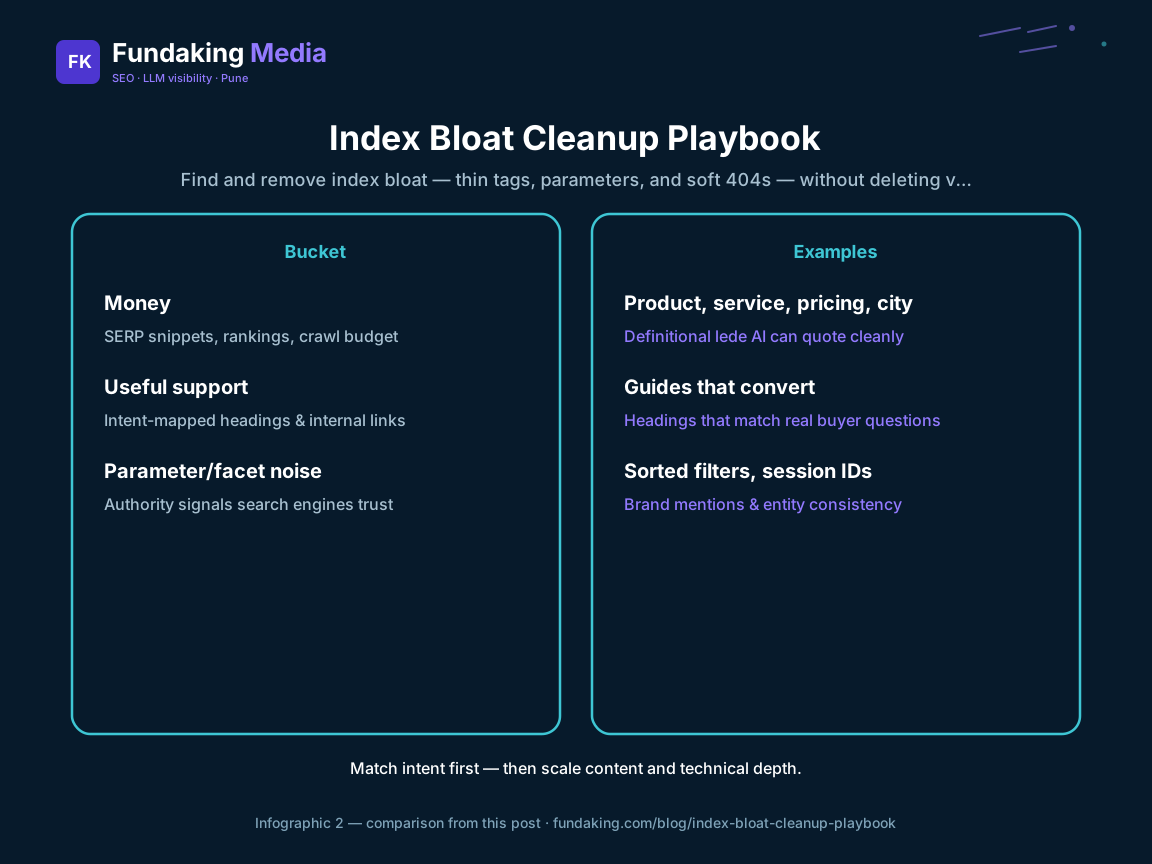
Export GSC pages report + site crawl. Segment URLs:
| Bucket | Examples | Default action |
|---|---|---|
| Money | Product, service, pricing, city | Keep; fix if soft-404 |
| Useful support | Guides that convert | Keep; improve links |
| Parameter/facet noise | Sorted filters, session IDs | noindex/canonical/block |
| Thin archives | Empty tags, date archives | noindex |
| Expired campaigns | Old landing pages | 301 to successor or 410 |
Never mass-noindex without sampling 20 URLs per bucket.
Cleanup tactics ranked by risk
- Canonical/facet rules — lowest drama for ecommerce
- robots/meta noindex on confirmed thin templates
- Parameter handling in GSC (legacy) + server rules
- 301 only with a clear replacement
- 410/404 for dead weight with no successor
Document every rule in a Sheet: pattern, action, owner, date.

21-day cleanup programme
Week 1: Segment + sample. Week 2: Ship rules on staging; validate. Week 3: Production + monitor coverage/impressions on money URLs daily.
Pair with XML sitemap best practices so the sitemap stops advertising junk. For AI-era pruning nuance see prune/noindex in the AI era.
FAQ
Will pruning tank traffic?
Not if money URLs are protected and sampled. Reckless bulk noindex will.
How do we know it worked?
Indexed count falls while money-URL impressions hold or rise.
Who should approve deletions?
Marketing + eng together; SEO alone should not 410 product URLs.
Is bloat only an ecommerce problem?
No — publishers with tag/date archives suffer too.
Need help?
Technical SEO consulting for crawl/index triage.
Sampling protocol
For each URL pattern, open 20 random samples. If ≥80% are thin/duplicate, the pattern rule is justified. If mixed, split the pattern before acting.
Communication with leadership
Show indexed count vs organic sessions on money URLs. Executives fear pruning; show that noise URLs contribute near-zero sessions.
Re-bloat prevention
Add CI or publish checklist: new templates default to sensible index rules; UTM parameters never become indexable; tag creation restricted.
Engineering tickets that finish “Index Bloat Cleanup Playbook”
Solo marketer path
You have ten hours a week. For “Index Bloat Cleanup Playbook”, pick one revenue URL this topic supports, write acceptance criteria for engineering (status code, visible copy, schema match), and ship a single scannable asset sales can forward after a call. Refuse new blog ideas until that URL is green in Search Console and linked from your cluster hub.
Track work in a Sheet with columns: URL, owner, due date, status, KPI (demos, calls, WhatsApp, or qualified pipeline). Review it in the pipeline meeting — not a separate SEO theatre call.
Already-have-an-agency path
Use this article as a scorecard. Ask for evidence that the checks here are done on your money URLs. If the agency only returns keyword greenery, escalate once with a written 14-day recovery plan. If they cannot speak to the substance of “Index Bloat Cleanup Playbook”, change the operating model.
Scaling-content path
Volume is not the strategy. Gate every new outline on: which prompt or query it supports, which URL owns it, and which demo stage it influences. “Index Bloat Cleanup Playbook” should appear in the quarterly roadmap with a named owner and a kill criterion if pipeline does not move.
Commercial QA gates for “Index Bloat Cleanup Playbook”
Discovery
- Five buyer prompts or queries documented from sales or support
- Primary URL chosen; competing URLs listed for consolidation
- Screenshot baseline of SERP / Maps / AI answer dated
Execution
- Technical gates on the primary URL pass (200, indexable, facts in HTML)
- First screen rewritten in buyer language, not internal jargon
- At least one table, process list, or FAQ block that can be quoted
- Hub ↔ spoke ↔ service ↔ proof links with descriptive anchors
Proof and QA
- Claims with numbers are dated or scoped to India / segment
- Organization and author facts match About and schema
- Sales reviewed the page and would send it to a prospect
Measurement
- KPI tile exists on the founder dashboard
- Biweekly or weekly review assigned
- Decision logged after 30 days: double down, fix, or cut
Pushbacks I hear on “Index Bloat Cleanup Playbook”
“We need more content first.”
Not if money URLs fail crawl or contradict pricing. Volume without architecture dilutes topical authority and wastes writers.
“Our agency said rankings are up.”
Ask for demos and the five-query sheet. Rankings without pipeline are a vanity report.
“AI will handle this automatically.”
Models amplify whatever facts you publish. Wrong NAP, wrong pricing, and JS-only answers get amplified too.
“We are too early for SEO.”
You are not too early for clean money URLs and entity facts. You may be too early for a large content team — that is different.
Calendar — first 45 days on “Index Bloat Cleanup Playbook”
Days 1–5: Baseline data, choose primary URL, list P0 defects.
Days 6–15: Ship technical and factual fixes; rewrite lede + FAQ.
Days 16–30: Wire internal links; update service CTA; brief sales.
Days 31–45: Measure; screenshot again; decide next URL. Do not start URL #2 until URL #1 is honestly Pass on technical + entity checks.
Working with Fundaking on “Index Bloat Cleanup Playbook”
Scoped audit and roadmap when your team can execute tickets. Monthly advisory when priorities thrash. Hybrid is common: I prioritise and QA; your marketer and eng ship. Work runs from Pune / Baramati across India and remote teams. Start via the matching service page linked in Related reading, or book a call.
FAQ — implementation details for “Index Bloat Cleanup Playbook”
Does this replace the cluster hub article?
No — this spoke implements one job; the hub frames the pillar.
How do we keep pages from going stale?
Revisit when pricing, packaging, or service area changes. Stale BOFU claims are worse than thin TOFU posts.
What is the minimum evidence for case-study claims?
Named process and scoped outcomes you can defend on a sales call — not invented percentages.
Should every blog have the same CTA?
No. Match intent: Maps/WhatsApp for local, demo for SaaS, audit call for consulting.
When is “Index Bloat Cleanup Playbook” not P0?
When crawl/index on revenue templates is broken, or when ops cannot handle leads. Fix those constraints first.
Related reading on Fundaking
- Technical SEO Audit Checklist (2026)
- Pruning and Noindex in the AI Era
- Faceted Navigation SEO for Ecommerce
- Technical SEO consulting
- Fintech organic growth case study
Rahul Agarwal — Fundaking Media. SEO consultant based in Pune / Baramati, serving founders across India.
 Rahul Agarwal