

Google Maps ranking in India still hinges on relevance, distance, and prominence — but the operators who win in Pune, Baramati, and multi-city markets obsess over GBP hygiene, review velocity, and on-site city proof. Here is the 2026 working model I use with service businesses.
Factors I weight in audits
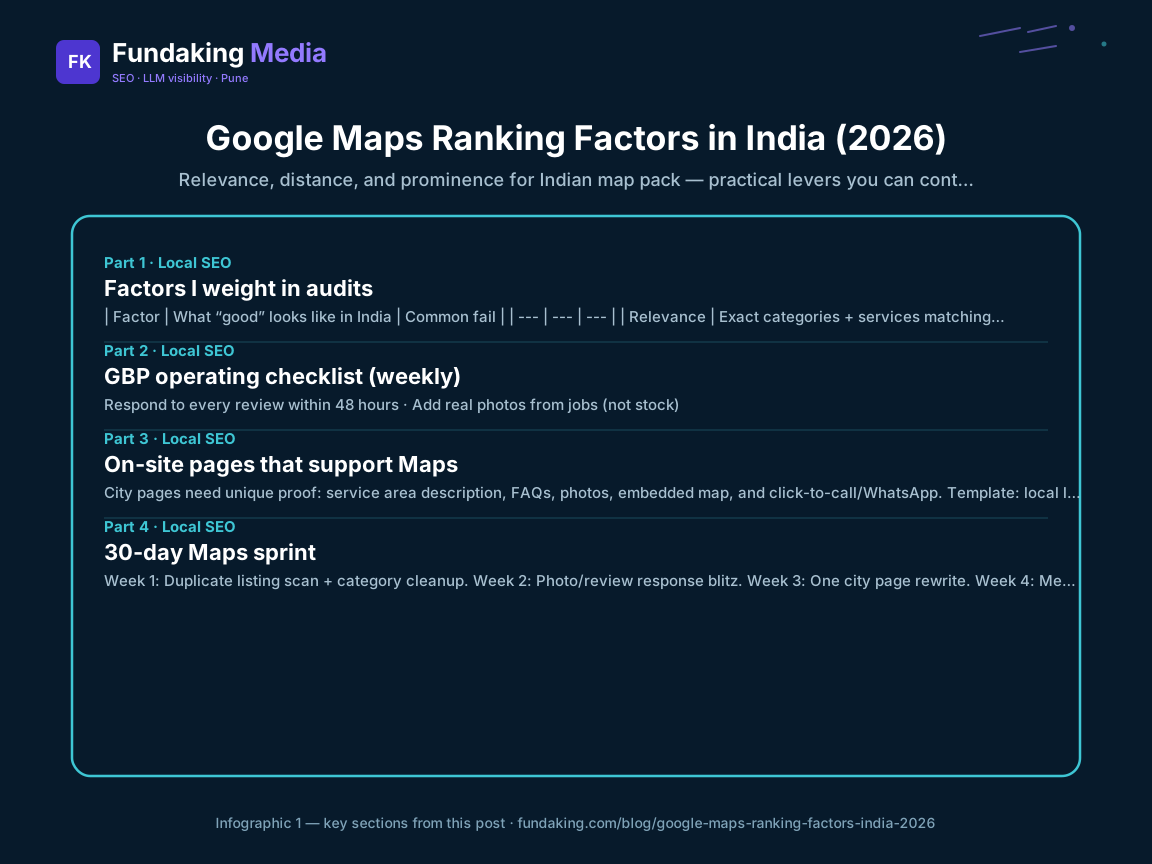
| Factor | What “good” looks like in India | Common fail |
|---|---|---|
| Relevance | Exact categories + services matching queries | Too-broad categories |
| Distance | Real service area; honest coverage | Fake pin / overclaiming cities |
| Prominence | Reviews, citations, brand search, links | Review gating or spam citations |
| GBP activity | Photos, posts, Q&A, products/services | Abandoned profile |
| On-site proof | Unique city/service pages | Spun city clones |
GBP operating checklist (weekly)
- Respond to every review within 48 hours
- Add real photos from jobs (not stock)
- Post once weekly with service + city language
- Keep hours, phone, WhatsApp, and website UTM consistent
- Monitor for duplicate listings weekly

On-site pages that support Maps
City pages need unique proof: service area description, FAQs, photos, embedded map, and click-to-call/WhatsApp. Template: local landing page India. Decision frame: local vs national SEO.
30-day Maps sprint
Week 1: Duplicate listing scan + category cleanup. Week 2: Photo/review response blitz. Week 3: One city page rewrite. Week 4: Measure calls/WhatsApp; compare pack screenshots.
Engage local SEO consulting when multi-location or agency networks create conflicting NAPs — proof: Real Group case study.
FAQ
Do backlinks still matter for Maps?
Yes as prominence — but spam directories without proximity relevance underperform.
Is review quantity or velocity more important?
Both; sudden fake spikes are risky. Steady authentic velocity wins.
Can we rank in a city without an office?
Service-area businesses can, with honest settings and strong proof — not fake addresses.
How often do factors change?
Weighting shifts; the hygiene basics rarely do.
Fastest win?
Fix categories, remove duplicates, respond to reviews, add 10 real photos.
Review acquisition that stays safe
Ask after successful jobs, provide easy links, never gate or incentivise dishonestly. Respond to negatives with facts and an offline path. Photo reviews with geo context help prominence.
Multi-location brands
Each location needs accurate pages and GBP entities. Shared phone numbers across cities create routing pain — prefer local numbers or clear IVR without NAP lies.
Pack vs local finder vs Maps app
Results differ by surface. Screenshot the surface your customers use (often mobile Maps). Optimising only desktop local finder misleads.
Local ops rituals that make “Google Maps Ranking Factors in India (2026)” stick
Solo marketer path
You have ten hours a week. For “Google Maps Ranking Factors in India (2026)”, pick one revenue URL this topic supports, write acceptance criteria for engineering (status code, visible copy, schema match), and ship a single scannable asset sales can forward after a call. Refuse new blog ideas until that URL is green in Search Console and linked from your cluster hub.
Track work in a Sheet with columns: URL, owner, due date, status, KPI (demos, calls, WhatsApp, or qualified pipeline). Review it in the pipeline meeting — not a separate SEO theatre call.
Already-have-an-agency path
Use this article as a scorecard. Ask for evidence that the checks here are done on your money URLs. If the agency only returns keyword greenery, escalate once with a written 14-day recovery plan. If they cannot speak to the substance of “Google Maps Ranking Factors in India (2026)”, change the operating model.
Scaling-content path
Volume is not the strategy. Gate every new outline on: which prompt or query it supports, which URL owns it, and which demo stage it influences. “Google Maps Ranking Factors in India (2026)” should appear in the quarterly roadmap with a named owner and a kill criterion if pipeline does not move.
Maps and NAP QA gates for “Google Maps Ranking Factors in India (2026)”
Discovery
- Five buyer prompts or queries documented from sales or support
- Primary URL chosen; competing URLs listed for consolidation
- Screenshot baseline of SERP / Maps / AI answer dated
Execution
- Technical gates on the primary URL pass (200, indexable, facts in HTML)
- First screen rewritten in buyer language, not internal jargon
- At least one table, process list, or FAQ block that can be quoted
- Hub ↔ spoke ↔ service ↔ proof links with descriptive anchors
Proof and QA
- Claims with numbers are dated or scoped to India / segment
- Organization and author facts match About and schema
- Sales reviewed the page and would send it to a prospect
Measurement
- KPI tile exists on the founder dashboard
- Biweekly or weekly review assigned
- Decision logged after 30 days: double down, fix, or cut
Pushbacks I hear on “Google Maps Ranking Factors in India (2026)”
“We need more content first.”
Not if money URLs fail crawl or contradict pricing. Volume without architecture dilutes topical authority and wastes writers.
“Our agency said rankings are up.”
Ask for demos and the five-query sheet. Rankings without pipeline are a vanity report.
“AI will handle this automatically.”
Models amplify whatever facts you publish. Wrong NAP, wrong pricing, and JS-only answers get amplified too.
“We are too early for SEO.”
You are not too early for clean money URLs and entity facts. You may be too early for a large content team — that is different.
Calendar — first 45 days on “Google Maps Ranking Factors in India (2026)”
Days 1–5: Baseline data, choose primary URL, list P0 defects.
Days 6–15: Ship technical and factual fixes; rewrite lede + FAQ.
Days 16–30: Wire internal links; update service CTA; brief sales.
Days 31–45: Measure; screenshot again; decide next URL. Do not start URL #2 until URL #1 is honestly Pass on technical + entity checks.
Working with Fundaking on “Google Maps Ranking Factors in India (2026)”
Scoped audit and roadmap when your team can execute tickets. Monthly advisory when priorities thrash. Hybrid is common: I prioritise and QA; your marketer and eng ship. Work runs from Pune / Baramati across India and remote teams. Start via the matching service page linked in Related reading, or book a call.
FAQ — implementation details for “Google Maps Ranking Factors in India (2026)”
Does this replace the cluster hub article?
No — this spoke implements one job; the hub frames the pillar.
How do we keep pages from going stale?
Revisit when pricing, packaging, or service area changes. Stale BOFU claims are worse than thin TOFU posts.
What is the minimum evidence for case-study claims?
Named process and scoped outcomes you can defend on a sales call — not invented percentages.
Should every blog have the same CTA?
No. Match intent: Maps/WhatsApp for local, demo for SaaS, audit call for consulting.
When is “Google Maps Ranking Factors in India (2026)” not P0?
When crawl/index on revenue templates is broken, or when ops cannot handle leads. Fix those constraints first.
Related reading on Fundaking
- Local SEO India Playbook: Maps, GBP, and Organic
- Google Business Profile Optimization for India
- NAP Consistency Across India Directories
- Local SEO consulting
- Real Group case study
Rahul Agarwal — Fundaking Media. SEO consultant based in Pune / Baramati, serving founders across India.
 Rahul Agarwal